Agarwood Business PH
Agarwood Farming in the Philippines
What to know before you plant a single tree
Last update: June 24, 2026
Agarwood farming carries real risk. What you will read below is for general information only. It isn't financial, investment, legal, or tax advice, and nothing in it is a personal recommendation to buy, plant, or invest in anything. Always consult a qualified professional.
Agarwood, also called oud, or lapnisan here in the Philippines, is a fragrant resin that forms inside certain tropical trees. It goes into incense, perfume, and traditional medicine, and it is one of the most expensive natural materials in the world (ScienceInsights, 2026).
About the author
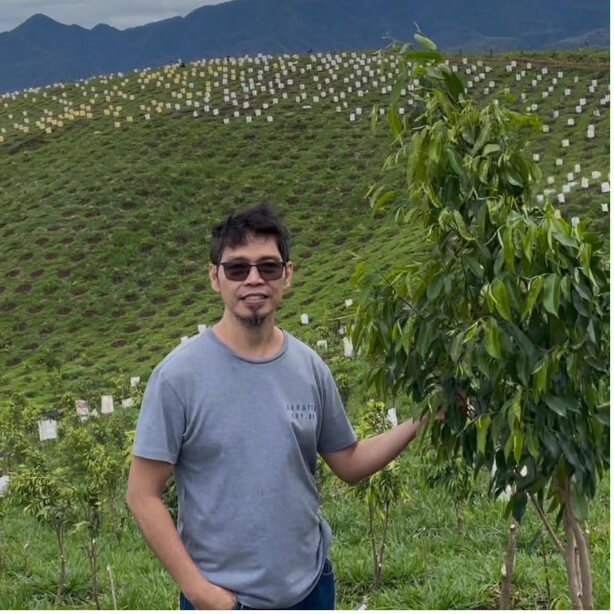
This photo was taken on February 13, 2026, at an agarwood plantation in Bukidnon.
I'm Jesse Veluz — an agarwood plantation partner, not an agronomist or a financial expert, and I don't pretend otherwise. I built this site to share what I've learned researching the agarwood farming industry, and to be upfront about what I haven't seen yet myself.
My own agarwood trees aren't mature enough to harvest yet, so I can't tell you exactly what they'll produce or what they'll sell for. What I can share is everything I've learned along the way, and that's what this page is largely based on.
Read this as careful research from someone still learning, which is why every claim in this report links back to a source you can check yourself.
Table of Contents
1
What is agarwood and why is it worth so much?
The wood is unremarkable until the tree is injured. Agarwood comes from a small group of tropical trees in the genus Aquilaria (ScienceInsights, 2026). Left alone, these trees are nothing special. The wood is pale, light, and barely has a scent.
The change happens through injury. When an Aquilaria tree is wounded or infected, often by insects or fungus, it fights back by making a dark, sticky resin to seal the wound. Over years, that resin spreads into the wood around it and turns it into agarwood: dense, dark, and fragrant.
This only happens to a small share of wild trees, and it happens slowly. Scarcity is widely cited as a major reason agarwood costs what it does. People want it for incense, especially across the Middle East. They distill it into oud oil, one of the priciest ingredients in perfume. And it shows up in traditional medicine across several Asian countries.
Because wild agarwood is now protected, cutting it from the wild is illegal almost everywhere it grows, including here. That is exactly why a legal, farmed supply became a real business instead of a black-market one.
Agarwood = the dark, scented resin that builds up inside a wounded Aquilaria tree over years. Without a wound, the tree never forms it.
2
Why the legal status matters
The permit system is a big part of what lets a legal market exist at all. Agarwood's main source trees came under international trade controls in 1995, when Aquilaria malaccensis was added to CITES Appendix II. By 2005, every species across the Aquilaria and Gyrinops groups was covered (CITES, Checklist of CITES Species). In plain terms, any country that wants a legal agarwood trade has to build its own permit system, from where seedlings come from all the way to how a finished shipment gets certified for export.
Some countries built that system early. India and Thailand have longer-established plantation industries than the Philippines. India's own history shows how messy this gets: it banned agarwood exports for years, lifted the ban in late 2021, and didn't secure a formal CITES export quota until April 2024 (Nitnaware, 2024). During that gap, reports suggest more agarwood moved through illegal channels, not less. Seizure records kept by the United Nations Office on Drugs and Crime show how stubborn the illegal trade is even under tight rules (United Nations Office on Drugs and Crime). Tight rules don't appear to reduce demand so much as shift where it gets met, legally or otherwise.
The Philippines came to this later. The legal pathway exists now, through Wildlife Culture Permits issued by the Department of Environment and Natural Resources (DENR, 2021), and the whole thing sits under Republic Act No. 9147 (Congress of the Philippines, 2001). But it is recent, and the list of companies that actually hold a permit is still short.
India reopened trade under a CITES-approved quota in 2024 after years of a ban (Nitnaware, 2024). If anything, that shows how much paperwork a legitimate agarwood trade takes, even in a country with a much bigger industry than ours.
3
Agarwood farming: why the Philippines, why now
The climate here suits agarwood fine; the holdup has been the legal framework. Agarwood needs a warm, tropical climate. Aquilaria malaccensis, the main source of high-grade agarwood in Southeast Asia, grows naturally across the Philippines (ScienceDirect, 2022). The biology isn't the constraint here. The legal setup is what's new.
Because the licensed industry is still small, there isn't much of a track record to point to yet, and less of a paper trail to check before you trust someone with your money. Early plantations exist in places like Bukidnon, and the right growing conditions exist in many provinces.
Incense markets in the Middle East and the global perfume industry both lean on agarwood. In growing agarwood, there is more than one way in: people with land can grow it themselves, and people without land have the managed plantation route I cover later.
There's at least one real-world study behind this, not just theory. Researchers in Thailand looked at the village of Ban Khlong Sai, comparing agarwood growing against the other ways people there earned a living and tracking its effects on the local economy, the community, and the land. They were careful in how they framed it, but the overall read was positive: the benefits looked to outweigh the drawbacks, and for that village, agarwood turned out to be a real way to make a living. That doesn't mean every plantation works out, or that profits are a sure thing. Change the location, the rules, the growing conditions, or the buyers, and the outcome can look completely different. But it does suggest that in the right place, under the right conditions, agarwood can be a genuine long-term crop rather than just wishful thinking (Jha, 2014).
4
How the agarwood business actually works
There are four steps, and cutting a corner on any of them tends to surface later rather than right away.
Start with legal seedlings
This decides everything else. If your seedlings didn't come from a properly registered source, it could create serious legal or documentation problems when it comes time to sell or export the harvest. The paper trail starts here, not at harvest.
Plant in the right place
Aquilaria trees handle a range of soils, but they grow faster and healthier with decent sun and water management.
Wait, then inoculate
Resin forms naturally when these trees get infected (Falcon et al., 2025). Growers can trigger the same response on purpose through inoculation: small, controlled holes paired with a substance that prompts the tree to make resin. A 2023 review found that several artificial methods can produce high-quality resin in plantation trees, in good conditions reaching quality comparable to wild agarwood (Ngadiran et al., 2023).
The tree has to be mature first. Most properly grown trees need around 5 years of healthy growth before they're ready, and after inoculation the resin itself takes roughly 2 years to fully develop. One 2025 study found there is no single right time to harvest. It depends on the type of tree. Most varieties they tested needed two full years to reach their best quality, but one peaked after just a year and got worse if growers waited (Li et al., 2025). So you can't use one harvest schedule for every tree. You have to know the variety first.
Find buyers who trust you
In my reading, selling is the step that's easiest to underestimate. Agarwood is valuable enough to attract fakes and low-grade material, so serious buyers are cautious. Earning the trust to sell at a fair price takes time. The legal paperwork gets you in the room. It does not guarantee anyone buys what's in your hand.
5
Two ways to get involved in agarwood farming
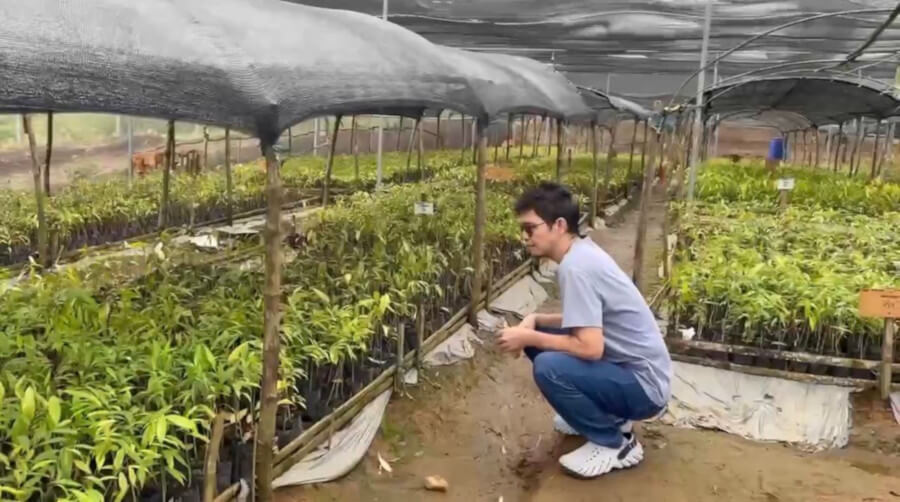
You don't need a big operation to take part. Broadly, there are two paths. Both follow the same four fundamentals above. The only real difference is who does the day-to-day farming.
| Option | How it works | Best for |
|---|---|---|
| Grow it yourself | You plant agarwood on land you already own, with guidance on legal seedlings, planting, and inoculation when the time comes. | People who own suitable land and want to be hands-on. |
| Managed plantation | Your trees are planted and cared for on a shared plantation. Each tree is tagged, so on paper you still own your specific trees. | People who want a way into agarwood without managing land themselves. |
6
Common myths worth knowing
Because agarwood is valuable, there's no shortage of people pitching shortcuts. Here are the claims worth questioning.
"You can inoculate the tree after just 1 or 2 years."
Properly grown agarwood usually needs around 5 years of healthy growth before inoculation produces good results. If someone promises a much faster timeline, ask them to back it up; the published growth ranges suggest it's unlikely.
"An export permit means I've already made it."
An export permit (often called a CITES permit) proves your agarwood came from a legal source and lets you ship it abroad. It says nothing about whether you have buyers, or whether your agarwood is good enough to sell at a strong price. Those are separate problems you still have to solve.
"Any injection works as well as proper inoculation."
Almost anything injected into the tree triggers some kind of resin response. But buyers can tell a properly developed resin from a rushed, artificial one. Quality is what decides whether a harvest is actually worth much.
"Plant it, forget it, become a millionaire in a few years."
This is a long-term farming business, not a shortcut. It tends to reward patience and good technique more than speed, and a lot of it comes down to building buyer relationships over years.
Offers of a faster or easier path to agarwood income than what's described here are worth questioning closely before you act on them.
7
Where an agarwood business loses money
Agarwood trees take 6 to 10 or more years to mature, and storms, pests, or just bad site selection can wipe out a real share of any planting. If your plan assumes nothing goes wrong with the core asset, the plan is wrong.
Agarwood farming sounds like easy money in a lot of the marketing around it, but the actual risk profile is steep. Prices are far less predictable than the headlines suggest. Low- and mid-grade resin, which is what new growers usually end up with, makes up most real harvests and sells for far less than the famous top-grade numbers. Top-grade agarwood has reportedly reached around ₱6 million per kilo, but that is the rarest grade and only a small fraction of trees (Ash, 2020); it's a ceiling almost no plantation reaches rather than anything to plan around.
There's a legal layer too. Growers need a Wildlife Farm or Culture Permit from the DENR before planting, and skipping it isn't a paperwork technicality. Unpermitted resin may be confiscated, and the grower can face criminal liability under RA 9147. The exact consequences depend on the specifics, so confirm current rules with DENR and a Philippine lawyer.
On top of all that sit the ordinary risks of any slow-maturing tree crop. A land dispute can erase years of investment before a single tree is ready, and planting at the wrong time of year without irrigation to cover it can kill seedlings before they get the chance to mature (Agriculture.com.ph, 2026).
8
What the numbers could look like
Here's an example. Up front: these are illustrative estimates, not promises, and I want that clear before I show you a single peso figure.
Actual results depend on tree health, growing conditions, inoculation quality, and market prices at harvest time. All of those can swing a lot, and none of them can be locked in today.
You may have seen the eye-watering numbers. One Business Insider report put first-grade agarwood as high as $100,000 per kilogram (Ash, 2020). I'm not using that figure. It reflects the rarest grade there is, a small fraction of Aquilaria trees, and most plantation harvests never get close.
I'd rather use the prices real harvests tend to produce. For reference, researchers who spent nine months watching online agarwood trading in the Philippines found actual agarwood selling from about $782 to $5,865 per kilogram, roughly ₱46,920 to ₱351,900 (Sy & Melgar, 2024).
My assumptions, kept deliberately modest
- Each mature tree might produce somewhere around 0.7 to 1 kilogram of sellable material. I want to be clear this is a borrowed assumption, not something I've measured. My own trees aren't mature yet, and published plantation yields vary widely. Treat it as a placeholder for the math below, not a yield you're owed, and ask any operator you're considering for their documented average yield per harvested tree.
- For the first table below I've used ₱100,000 per kilogram. It sits inside the range Philippine researchers recorded in online agarwood sales, though toward the hopeful end of it. I'm not saying that's a typical or expected price, and I'm definitely not saying your harvest will hit it — it's just a round number to keep the math easy to follow. What you'd actually get could be a lot lower, or higher, and it moves with resin quality, who's buying and how much they want it, whether your documentation is in order, and plenty of things nobody can call ahead of time.
- Another reason I use ₱100,000/kg for the math is that this figure was mentioned in House Bill No. 10320 (House of Representatives of the Philippines, 2024). That number comes from a proposed bill rather than recorded sales, so it's on the hopeful side. Recorded online sales in the Philippines have ranged far lower, from about ₱47,000/kg, so read the figures below as a best case, not a midpoint.
- The timeline allows about 5 years of growth before inoculation, plus roughly 2 years for the resin to develop. That's a 7 to 8 year journey from planting to harvest.
Estimated harvest value at year 7 to 8
These figures are hypothetical illustrations meant to show how harvest value scales with tree count. They should not be read as expected returns, typical outcomes, forecasts, or income projections. Actual results may be a lot lower or higher, and may include partial or total loss of the money you put in.
| Number of trees | Est. harvest weight | Est. gross value (₱) |
|---|---|---|
| 250 trees | ~175–250 kg | ₱17,500,000–₱25,000,000 |
| 500 trees | ~350–500 kg | ₱35,000,000–₱50,000,000 |
| 1,000 trees | ~700–1,000 kg | ₱70,000,000–₱100,000,000 |
| If trees die, prices fall, or no buyer appears | Less, possibly nothing | Down to ₱0 |
This time I've run the table at about ₱47,000 per kilogram, near the low end of what Philippine researchers actually recorded in online agarwood sales, just to show how far the totals move when you change the price. Even that isn't a forecast or a number you're owed. Real prices go up and down with resin quality, how much buyers want it, whether your paperwork holds up, and whether there's even a buyer around when your harvest is ready.
| Number of trees | Est. harvest weight | Est. gross value (₱) |
|---|---|---|
| 250 trees | ~175–250 kg | ₱8,225,000–₱11,750,000 |
| 500 trees | ~350–500 kg | ₱16,450,000–₱23,500,000 |
| 1,000 trees | ~700–1,000 kg | ₱32,900,000–₱47,000,000 |
| If trees die, prices fall, or no buyer appears | Less, possibly nothing | Down to ₱0 |
What this table doesn't show. These are gross values, before land, seedlings, maintenance, inoculation, processing, and the sale itself eat into them. I'm not putting a net number next to the gross one, because I don't have a verified cost breakdown I'd be comfortable standing behind, and guessing at a percentage would create exactly the kind of unsupported figure I've tried to avoid. If you want a realistic net picture, ask whichever operator you're considering for their actual costs, then run the math yourself.
It also assumes every tree survives to harvest, and that a buyer exists at the assumed price when your harvest is ready. Neither is automatic. Use the table only to get a rough sense of scale; it is not a number to count on.
9
If you don't own land
Here's how managed plantations work. If you don't have farmland, don't have time for day-to-day growing, or just want someone experienced handling the technical side, a managed plantation is one way in that some companies offer.
Treat anything a managed plantation operator tells you as their own description of themselves. Before you commit any money, check the company's permit status, ownership paperwork, fee schedule, guarantees, and other material terms yourself.
Here's roughly what being a plantation partner is supposed to look like, based on how these setups are usually described. Read each one as a thing to verify, not a thing to assume.
- You own the trees, at least on paper. This usually isn't shares in some pooled fund. They're your specific, tagged trees, and you keep ownership and decisions over them from planting to harvest. Don't take that as a given, though. Check it against the actual contract.
- Maintenance is usually a fixed annual fee. Fees and terms vary by company and change over time, so confirm the current number directly with whoever you're considering before you commit to anything.
- Some setups include a mortality replacement guarantee. It often covers the first few years. If a tree dies in that window, some companies will swap it for one the same age at no extra charge. Guarantee terms are exactly the kind of thing that changes, so confirm it yourself rather than trusting a description.
- The pitch is always lower risk and less hands-on work. The idea is that the operator controls the growing conditions. Ask current partners whether it actually holds up. Don't just take the company's word.
10
Frequently asked questions
"Is agarwood farming legal in the Philippines?"
Yes, but it is highly regulated. Growers need a Wildlife Farm or Culture Permit from the Department of Environment and Natural Resources (DENR) before planting (DENR, 2021), and the whole thing sits under Republic Act No. 9147 (Congress of the Philippines, 2001). Growing or harvesting without a permit may expose you to confiscation and criminal liability; the exact consequences depend on the specifics, so confirm current rules with DENR and a lawyer.
"How long does agarwood take to grow before harvest?"
Most properly grown trees need around 5 years of healthy growth before inoculation, and the resin then takes roughly 2 years to develop (Li et al., 2025). That is about a 7 to 8 year journey from planting to harvest. Some sources put the full range at 6 to 10 or more years.
"How much is agarwood worth per kilogram?"
Price varies enormously by grade. A nine-month study of online agarwood trading in the Philippines found material selling from about US$782 to US$5,865 per kilogram.(Sy & Melgar, 2024) Top grades have reportedly fetched far more, but that rarest material shows up in only a small fraction of trees, and most plantation harvests never reach it.
"Do I need to own land to start an agarwood business?"
No. There are broadly two paths: growing trees on land you already own, or joining a managed plantation where an operator plants and cares for tagged trees you own on paper. The managed route is aimed at people who want a way into agarwood without managing land themselves.
"What are the main risks of agarwood farming?"
It is a long-term, illiquid agricultural venture. Trees can die from storms, pests, or poor site selection; prices are unpredictable and most new growers end up with lower- and mid-grade resin; permits are mandatory and skipping them is illegal; and a land dispute or badly timed planting can erase years of work. You could lose part or all of the money you put in. None of this is financial advice, so talk to a qualified professional about your own situation.
Explore how one managed plantation operates in the Philippines
Everything above is general information about agarwood farming and how managed plantations work. The next page examines one specific provider, describes its plantation model and operations, and includes an inquiry form for readers who want to learn more or contact the company directly.
Before you click: I'm an ambassador for the company on the next page, and I earn a referral fee at no additional cost to you if you become their client through me. I'd rather you know that now than find out later. This page and the next are provided for general informational purposes only and do not constitute financial, investment, legal, or tax advice.
Yes, I want to see how one plantation provider operatesReferences
- Agriculture.com.ph (February 17, 2026). Agarwood's multimillion-peso potential and role in biodiversity restoration.
https://agriculture.com.ph/2026/02/17/agarwoods-multimillion-peso-potential-and-role-in-biodiversity-restoration/ ↩ - Ash, Andy (Aug 27, 2020). Why agarwood is so expensive. Business Insider.
https://www.businessinsider.com/why-agarwood-is-so-expensive-oud-vietnam-2020-8 ↩ ↩ - CITES, Checklist of CITES Species, Aquilaria malaccensis.
https://checklist.cites.org/#/en ↩ - Congress of the Philippines (2001). Republic Act No. 9147: An Act Providing for the Conservation and Protection of Wildlife Resources and Their Habitats, Appropriating Funds Therefor and for Other Purposes.
https://lawphil.net/statutes/repacts/ra2001/ra_9147_2001.html ↩ ↩ - DENR (November 24, 2021). DENR: Agarwood propagation allowed but 'highly regulated'.
https://mirror.pia.gov.ph/press-releases/2021/11/24/denr-agarwood-propagation-allowed-but-highly-regulated ↩ ↩ - Falcon, F.D., Felicen, F.F., Balanon, B.D., & Refuerzo, A. (2025). Chemical induction for agarwood formation: a recent review.
https://www.researchgate.net/publication/393570971_Chemical_induction_for_agarwood_formation_a_recent_review ↩ - House of Representatives of the Philippines (2024). House Bill No. 10320: An Act for the Promotion and Development of the Agarwood Industry, and Appropriating Funds Therefor.
https://docs.congress.hrep.online/legisdocs/basic_19/HB10320.pdf ↩ - Jha, K., June 2014, Agarwood Plantation and Products as Livelihood Strategy: A Case Study From Ban Khlong Sai Village, Northeast Thailand.
https://www.academia.edu/27761419/AGARWOOD_PLANTATION_AND_PRODUCTS_AS_LIVELIHOOD_STRATEGY_A_CASE_STUDY_FROM_BAN_KHLONG_SAI_VILLAGE_NORTHEAST_THAILAND?email_work_card=title ↩ - Li, M., Yang, Z., Hong, Z., Xu, D., Li, Z., & Wang, S. (2025). Effects of different clones and inducing time on agarwood quality in grafted Qi-Nan Aquilaria sinensis (Lour.) Spreng. PLOS ONE, 20(7), e0327514.
https://journals.plos.org/plosone/article?id=10.1371/journal.pone.0327514 ↩ ↩ - Ngadiran, S., Baba, S., Nor, N. F. A., Yahayu, M., Muhamad, M. F., Kushairi, A. K. A., Zaidel, D. N. A., & Muhamad, I. I. (2023). The induction techniques of resinous agarwood formation: A review. Bioresource Technology Reports, 21, 101337.
https://doi.org/10.1016/j.biteb.2023.101337 ↩ - Nitnaware, H. (2024, July 30). CITES notifies increase in annual export quota for Indian agarwood.
https://www.downtoearth.org.in/forests/cites-notified-increase-in-annual-export-quota-for-agarwood-in-india ↩ ↩ - ScienceDirect (Volume 57, March 2022). DNA databases of a CITES-listed species Aquilaria malaccensis (Thymelaeaceae) as the tracking tools for forensic identification and chain of custody certification.
https://www.sciencedirect.com/science/article/abs/pii/S1872497321001939 ↩ - ScienceInsights (March 24, 2026). What Is Agarwood and Why Is It So Expensive?
https://scienceinsights.org/what-is-agarwood-and-why-is-it-so-expensive/ ↩ ↩ - Sy, E. Y., & Melgar, A. G. (January 2024). The online agarwood trade and seizure analysis in the Philippines.
https://www.researchgate.net/publication/377729889_The_online_agarwood_trade_and_seizure_analysis_in_the_Philippines ↩ ↩ - United Nations Office on Drugs and Crime. Agarwood (Oud), World WISE data, p. 5.
https://www.unodc.org/documents/wwcr/Agarwood.pdf ↩